

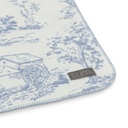

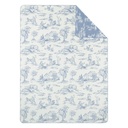


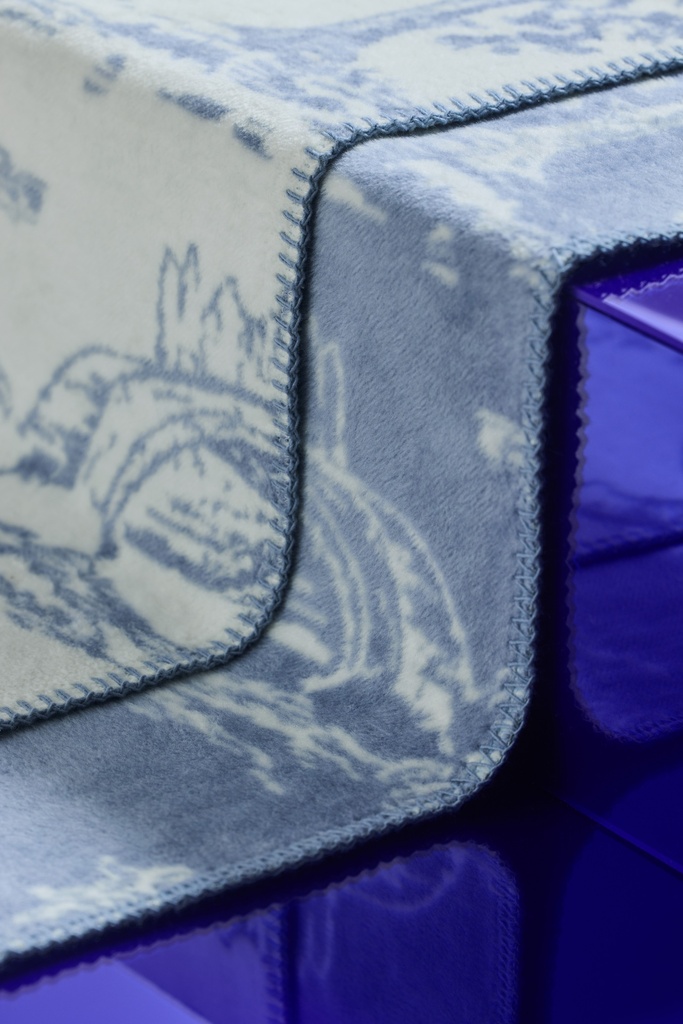
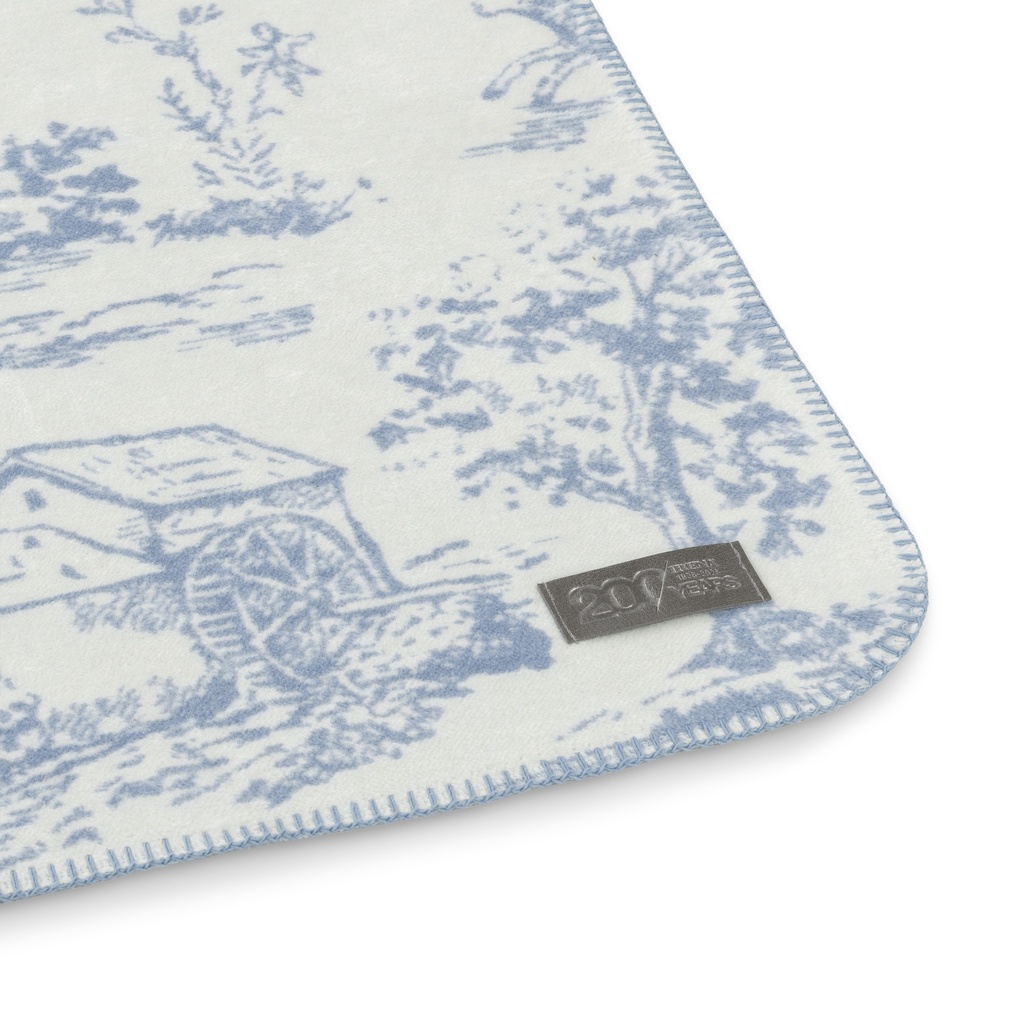
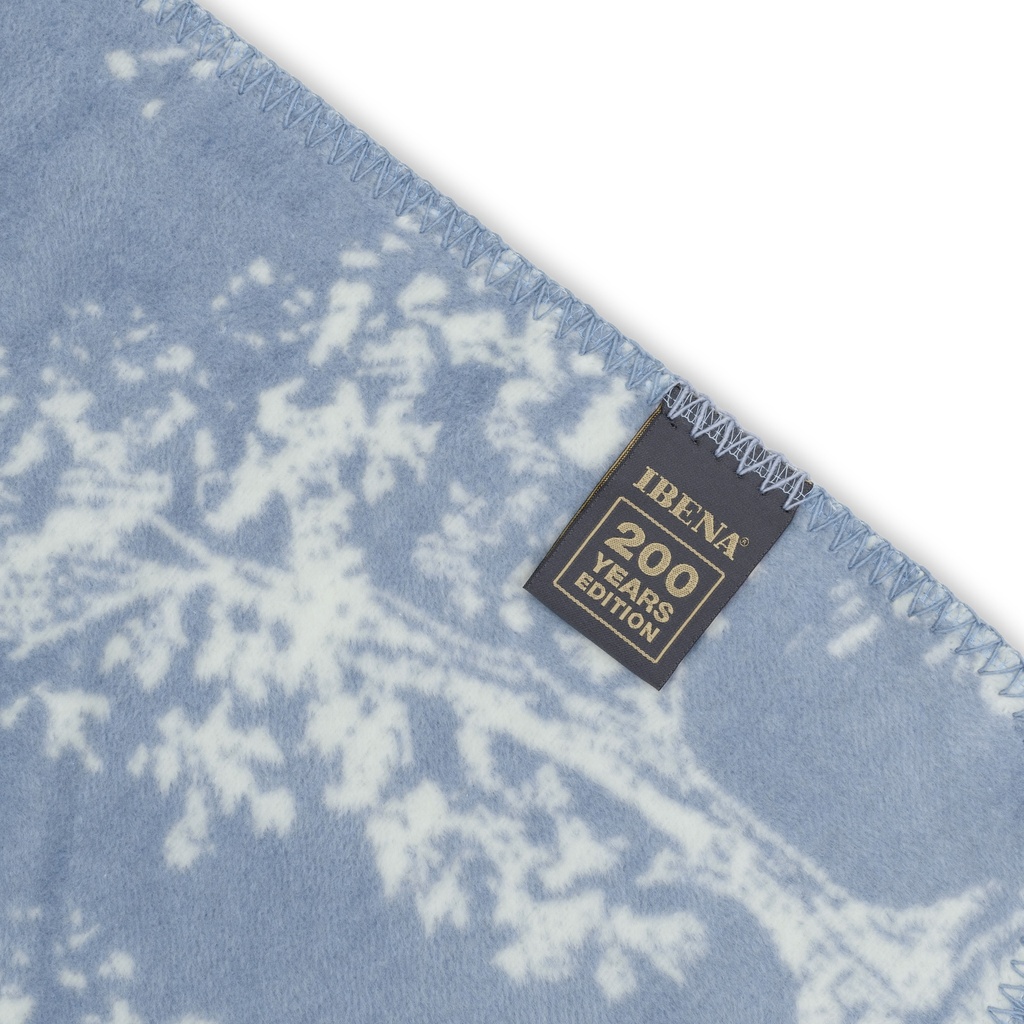
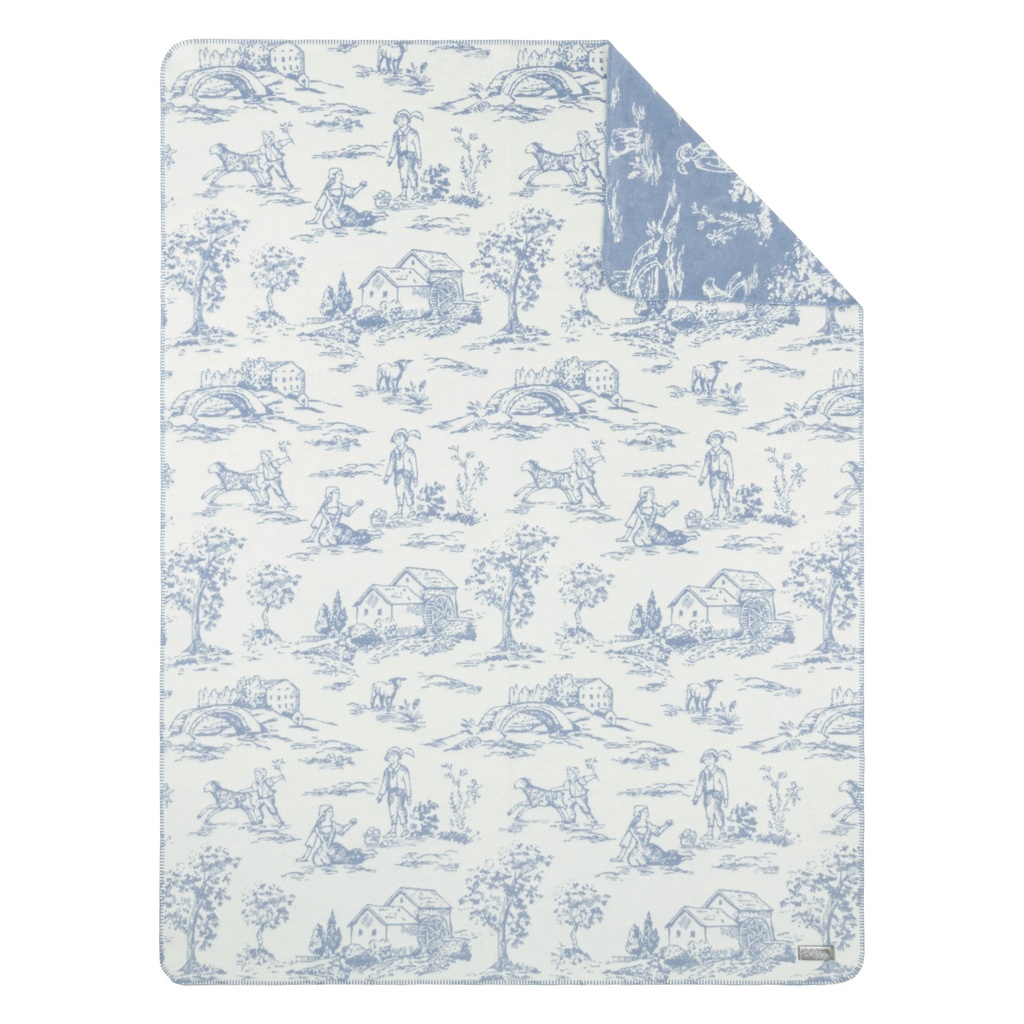

Inspired by the Romantic era, this piece features delicate rural motifs softly rendered in blue on white, as if applied with a brush. The all-over design recalls the traditional toile de Jouy pattern that originated in 18th-century France and became very popular in interiors and fashion. The toile has almost a storytelling quality, inviting the viewer to linger and discover details, bringing the artistry and craftsmanship of a bygone time into the present. Bring a piece of nostalgia into your home and enjoy it's comfortable warmth and softness while making your own history.
Certified by OEKO-TEX® Standard 100 which ensures that the blanket contains no chemicals harmful to humans or animals.
1826 was a year of quiet revolutions. Europe had only just begun to breathe again after the twenty-three-year Napoleonic Wars that had shaken the continent to its very foundations. The Battle of Leipzig lay only thirteen years in the past. For an entire generation, war had been the normal state of life. Now peace had finally returned—but the world had changed. Old certainties lay in ruins: kings had been overthrown, borders redrawn, and social orders turned upside down. In the midst of uncertainty, people searched for new anchors and often found them in small things, in the familiar, in craftsmanship. While grand politics still struggled to regain stability, a new era was quietly taking shape in workshops and trading houses.
The Longing for Meaning
In the German lands, the desire for authenticity was especially strong. Romanticism had captured hearts with its love of nature, old fairy tales, and all that seemed original and unspoiled. Few authors fueled the Romantic movement as powerfully as Goethe, particularly through his early works. In the 1820s, he completed the second part of Faust, a monumental late work published posthumously in 1832. Caspar David Friedrich painted his mist-shrouded landscapes, the Brothers Grimm collected folk tales, and in refined salons people read aloud from the works of Novalis and Eichendorff. This romantic longing was also reflected in fashion and interior design. Toile de Jouy—delicate fabrics adorned with pastoral scenes—experienced a revival. Idyllic landscapes and mythological motifs alike told of a world people yearned to reclaim or escape into through imagination.
Between Tradition and New Beginnings
The 1820s also marked a time of awakening. In England, steam engines were already rattling away, and in Germany, enterprising minds began to harness new technologies. The textile industry led this transformation—mechanical looms gradually displaced handcraft, and cotton from distant lands competed with domestic linen. It was in this age of contrasts that Josef Philipp Beckmann founded his textile trading company, “J. Beckmann,” in Wesel. The merchant quickly recognized the potential of the location: from its position on the Rhine, a vital waterway, and close to the textile production of the Westmünsterland, he rapidly opened up new markets for his linen and silk-cotton fabrics. He gained customers along the Rhine and Moselle, in the Eifel and the Palatinate. It was a bold step in uncertain times—but perhaps precisely for that reason, the right one. While others hesitated, he understood what truly mattered: people needed quality they could rely on.
A Thread Is Spun
What Josef Philipp Beckmann could not have known at the time was that he was spinning the very first thread of a story that would endure for two hundred years. In a time of upheaval, he created something lasting. In an age of uncertainty, he offered trust. And in a world wavering between tradition and modernity, he found a way to unite both.


Inspired by the Romantic era, this piece features delicate rural motifs softly rendered in blue on white, as if applied with a brush. The all-over design recalls the traditional toile de Jouy pattern that originated in 18th-century France and became very popular in interiors and fashion. The toile has almost a storytelling quality, inviting the viewer to linger and discover details, bringing the artistry and craftsmanship of a bygone time into the present. Bring a piece of nostalgia into your home and enjoy it's comfortable warmth and softness while making your own history.
Certified by OEKO-TEX® Standard 100 which ensures that the blanket contains no chemicals harmful to humans or animals.
1826 was a year of quiet revolutions. Europe had only just begun to breathe again after the twenty-three-year Napoleonic Wars that had shaken the continent to its very foundations. The Battle of Leipzig lay only thirteen years in the past. For an entire generation, war had been the normal state of life. Now peace had finally returned—but the world had changed. Old certainties lay in ruins: kings had been overthrown, borders redrawn, and social orders turned upside down. In the midst of uncertainty, people searched for new anchors and often found them in small things, in the familiar, in craftsmanship. While grand politics still struggled to regain stability, a new era was quietly taking shape in workshops and trading houses.
The Longing for Meaning
In the German lands, the desire for authenticity was especially strong. Romanticism had captured hearts with its love of nature, old fairy tales, and all that seemed original and unspoiled. Few authors fueled the Romantic movement as powerfully as Goethe, particularly through his early works. In the 1820s, he completed the second part of Faust, a monumental late work published posthumously in 1832. Caspar David Friedrich painted his mist-shrouded landscapes, the Brothers Grimm collected folk tales, and in refined salons people read aloud from the works of Novalis and Eichendorff. This romantic longing was also reflected in fashion and interior design. Toile de Jouy—delicate fabrics adorned with pastoral scenes—experienced a revival. Idyllic landscapes and mythological motifs alike told of a world people yearned to reclaim or escape into through imagination.
Between Tradition and New Beginnings
The 1820s also marked a time of awakening. In England, steam engines were already rattling away, and in Germany, enterprising minds began to harness new technologies. The textile industry led this transformation—mechanical looms gradually displaced handcraft, and cotton from distant lands competed with domestic linen. It was in this age of contrasts that Josef Philipp Beckmann founded his textile trading company, “J. Beckmann,” in Wesel. The merchant quickly recognized the potential of the location: from its position on the Rhine, a vital waterway, and close to the textile production of the Westmünsterland, he rapidly opened up new markets for his linen and silk-cotton fabrics. He gained customers along the Rhine and Moselle, in the Eifel and the Palatinate. It was a bold step in uncertain times—but perhaps precisely for that reason, the right one. While others hesitated, he understood what truly mattered: people needed quality they could rely on.
A Thread Is Spun
What Josef Philipp Beckmann could not have known at the time was that he was spinning the very first thread of a story that would endure for two hundred years. In a time of upheaval, he created something lasting. In an age of uncertainty, he offered trust. And in a world wavering between tradition and modernity, he found a way to unite both.

To install this Web App in your iPhone/iPad press
 and then Add to Home Screen.